PPA optimization engine for semiconductor teams

Cut the PPA optimization loop from months to weeks.

RTL Arena gives chip teams a second optimization brain: diagnose weak paths, explain tradeoffs, rank bounded fixes, and prove before/after QoR while engineers keep final control.

Read-only diagnosis firstEngineer approval gatesWorks beside EDA flows
3-4 momanual PPA loop
~2 wktargeted closure sprint
20K+LOC-aware RTL agent
<60mread-only audit target

Three surfaces, one closure loop

Not a chatbot. An optimization workbench with proof.

The product line is built around the final stretch before tape-out: understand the block, explain the path, propose a bounded fix, prove the QoR delta, and preserve the engineer's decision boundary.

01Deterministic first

PPA Optimization Engine

Profiles timing, power, and area weak spots, ranks source-traceable techniques, and keeps every recommendation tied to evidence.

WNS/TNSFmaxPowerArea
02Verilog-native

RTL Arena Agent

Explains blast radius, produces bounded RTL candidates, and waits for engineer approval before touching customer design files.

RTL diffGuardrailsRollbackChecks
03Existing-flow compatible

Flow Evidence Viewer

Turns compile, lint, synthesis, timing, schematic, and QoR artifacts into one shared review surface for engineers and leadership.

ReportsArtifactsExportLedger

Controlled workflow

A clear path from PPA chaos to a verified closure loop.

Every stage reduces ambiguity: the engine turns scattered EDA artifacts into a ranked, reviewable, and re-verified optimization path.

01ContextRTL / SDC / Liberty
02Profilecritical path ledger
03Rankbounded candidates
04Provebefore / after QoR
Trust orderdiagnose -> explain -> recommend -> compare -> approved change
Step 1Read-only mode

Ingest the live design context

RTL or netlist, Liberty, SDC, constraints, timing reports, synthesis outputs, and available activity assumptions stay mapped to the engineer's environment.

RTL hierarchySDC / LibertyTiming reports
Step 2Baseline profile

Profile PPA weak regions

The engine builds a baseline, traces failing endpoints, highlights path contributors, and separates evidence-backed data from planning-grade estimates.

Critical pathFanoutSlack ledger
Step 3Engineer review

Rank bounded optimization candidates

Each candidate carries rationale, expected direction, risk, files affected, and the checks required before anyone accepts the change.

TechniqueRiskPatch scope
Step 4QoR report

Re-verify and report the delta

Accepted candidates are re-profiled into before/after QoR views so CTOs see effort, tradeoff, evidence grade, and remaining tape-out risk.

Before/afterEvidence gradeRollback

Evidence layer

Every recommendation carries the concern, the control, and the claim boundary.

The landing page intentionally avoids push-button tape-out claims. It frames RTL Arena as a controlled optimization engine that works inside the team's flow and reports only what the evidence supports.

Recommendation packetApproval required
ConcernWNS sink
Controlbounded diff
Claim boundaryplanning-grade
RecheckQoR delta
Will it bypass review?

Guided mode is default. Automated edits require explicit approval, guardrails, and rollback metadata.

Are the numbers signoff-grade?

The page separates evidence-backed indicators from planning-grade estimates until signoff artifacts exist.

Does it replace Cadence or Synopsys?

No. RTL Arena sits beside the existing flow and reduces manual optimization burden.

Why trust an AI tool near tape-out?

The trust order is diagnose, explain, recommend, compare, then change only after approval.
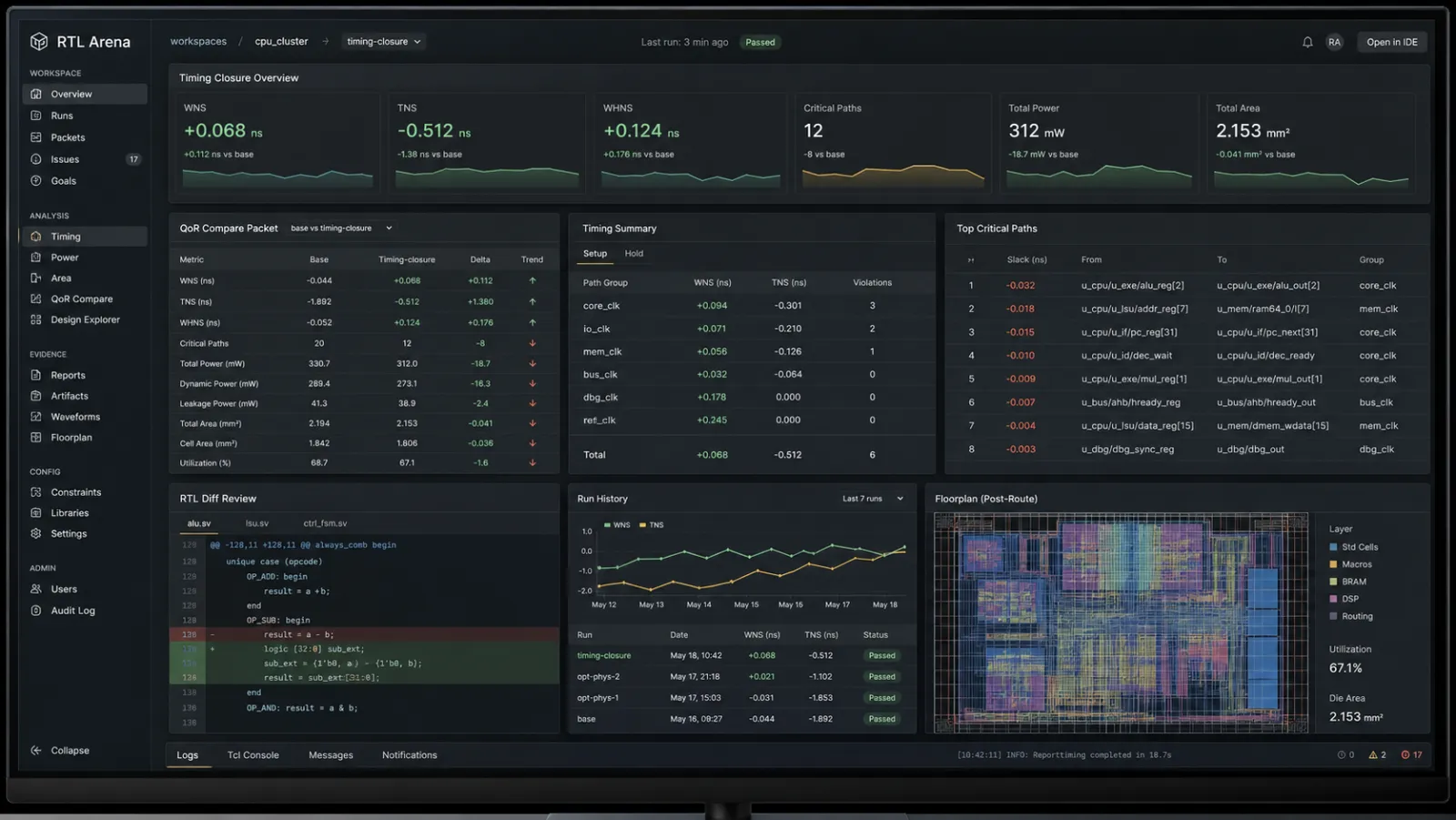
Mock performance numbers

Founder-friendly outcomes, engineer-readable math.

Illustrative only
EvidenceB+
Performance
Fmax +11.8%
Power
Leakage -6.4%
Area
Cell area -3.1%
Iteration
14 -> 5 loops
Loop count14 -> 5illustrative target
DimensionDeltaEvidence noteStatus
PerformanceFmax +11.8%WNS -0.18 ns -> +0.04 nsMock target
PowerLeakage -6.4%Planning-grade until routed evidenceBoundary visible
AreaCell area -3.1%Drive-strength and fanout tradeoffNeeds review
Iteration14 -> 5 loopsEDA runs avoided on target blockMock target

Who feels the urgency

Built for teams whose chip only wins if its PPA wins.

Fmax / WNS

AI accelerators

Performance-first teams where every Fmax recovery and closure iteration affects the product promise.

Power / area

Mobile and edge AI

Teams balancing performance with battery, thermals, leakage, and area pressure across constrained designs.

Loop cost

Data-center silicon

Mature organizations where expensive engineers and EDA cycles need a sharper ranked backlog.

Risk / proof

Automotive and industrial

Review-heavy flows where explainability, evidence boundaries, and controlled change are non-negotiable.

Pilot posture

Start with one pathological block. Prove the loop before broad rollout.

Day one is intentionally contained: baseline, ranked candidates, guided review, re-verification, report, and clear deferred items.

No raw RTL leaves by defaultApproval before editsBefore/after QoR export
Discuss pilot scope